Venture Studio Equity: What Founders Give and Get
How venture studio equity works for energy founders: typical ownership ranges, what drives the stake, vesting, IP and governance terms to review before signing.

Venture studio equity is the ownership a studio receives in a company it helps create, in exchange for ideas, capital, operating work and shared services. Reported stakes run from about 10% to 40% for classic studios, with some reaching 80%. The number is the least interesting part. What matters is what the studio contributes for it, how the stake vests and dilutes, and who controls the board once outside capital arrives. In energy, where a project can need years of permitting, offtake contracts and project finance before it earns revenue, that trade is worth testing closely.
Key Takeaways
- Classic studios commonly take 10% to 40% of a new company, and a stake can reach 80% when the studio builds nearly everything. Academic work puts the average near 34%.
- The stake follows the studio's role: the more capital, operating work and team-building it supplies, the more ownership it earns.
- Vesting, IP assignment, board seats and anti-dilution terms often shape a founder's real position more than the headline percentage.
- For energy ventures, the question is whether the studio has actually permitted, financed and built projects like yours.
- Ask for the full set of agreements before agreeing to a percentage.
What venture studio equity actually is
A venture studio is an operating company that builds new companies repeatedly, rather than a fund that writes checks into companies others started. The Global Private Capital Association (GPCA) describes the typical workflow in its 2026 report: idea generation and market validation, a founder-in-residence, funded prototype work, then a carve-out into an independent legal entity with seed investment and ongoing back-office, compliance and governance support. If a venture reaches a working prototype but never becomes its own entity, the IP generated usually goes back to the studio.
The studio's equity is how it is paid for that work. Instead of a fee for every hour, it takes ownership at formation, often as common founder shares for the sweat and sometimes preferred shares for cash it puts in. The GPCA also notes that in the classic model, investors in the studio hold equity in the studio's holding company, so the studio's returns come from many ventures rather than one.
For a founder, that means the studio is a co-founder with a balance sheet and a team, not an outside investor reviewing a pitch.

How much equity studios take
No single number exists, because studios differ in what they supply. Here is what the better sources report.
| Source | Reported studio stake |
|---|---|
| GPCA 2026 report | 10% to 40% for classic studios, up to 80% in some cases |
| Academic review citing the Global Startup Studio Network's 2020 white paper | Average about 34% at creation, range roughly 15% to 80% |
| Rausa Russo Law, October 2026 | 5% to 15% light-touch, 20% to 40% operating, majority or near-majority for co-founder studios |
The same academic review notes that venture capital firms usually take minority stakes of 15% to 40% and do not operate the company, whereas studios take larger stakes and give deeper operating support. The comparison is useful, but it is not like for like: a VC stake buys capital and guidance for a company that already exists, while a studio stake buys the company's creation.
Why the ranges are so wide
The spread comes from the studio's contribution, not from negotiation skill. The GPCA says the figure varies with the studio's level of involvement, the resources it provides and how complex the business model is. A pure back-office arrangement and a studio that originates the idea, recruits the CEO and funds the first build are different transactions that happen to share a name.
What drives the size of the stake
Rausa Russo Law, a U.S. firm that writes on studio structuring, ties the stake to the role the studio plays:
- Light-touch (5% to 15%). Back-office help, branding, recruiting and introductions, with no operating role.
- Operating (20% to 40%). Pre-product capital, a deep operator role and recruiting of the founding team.
- Co-founder (majority or near-majority). The studio originates the company, recruits the CEO and assembles the team.
For an energy venture, add three variables that software studios rarely face:
- Development capital at risk. Siting, interconnection, feedstock studies and early engineering cost money long before a financing closes. A studio that carries that cost takes real risk.
- Permitting and contracting. Permits and offtake or supply contracts are where energy projects stall. A studio that can run them is supplying something a founder cannot easily hire.
- Financeability. Lenders and equity investors want to see technical, commercial and financial dependencies resolved. Work that makes a project financeable raises the value of every share, including the founder's.
The useful founder question is not "is 30% fair?" but "what would it cost me to buy this work separately, and how long would it take?"
The terms that matter more than the percentage
Two founders with identical stakes can hold very different positions. Before you agree to a number, read the paperwork behind it.
Vesting and departure
Rausa Russo's co-founder-studio architecture has a recruited CEO commonly receiving 15% to 30% of post-formation fully diluted equity, vesting over four years with a one-year cliff. A cliff means no shares vest until the first anniversary. The same source says the CEO files an 83(b) election within 30 days of issuance. That is an IRS filing that lets you be taxed on restricted stock when it is issued rather than as it vests, so confirm the timing with your tax adviser the day you sign.
On departure, Promise Legal's guide says to look for repurchase of unvested shares at cost, transfer restrictions and rights of first refusal on vested shares, good-leaver and bad-leaver definitions, and post-exit non-solicit terms, which vary by state law. Milestone-based vesting, where shares vest as the venture hits defined technical or commercial goals, ties your ownership to delivered value.
The paper trail
Rausa Russo describes a clean studio engagement as papered through five documents: a Services Agreement with a defined sunset, a Stock Purchase Agreement, a Vesting Agreement, an IP Assignment Agreement and a Stockholders' Agreement. It adds that transactions in which the studio is on both sides should follow the safe-harbor procedure in Delaware's corporate statute, 8 Del. C. § 144. Ask for all five early, and have your own lawyer review them. This is a legal step where a founder needs an independent attorney, not a studio's.
IP assignment
Founder packages typically include an assignment of present and future inventions, disclosure of prior inventions and confidentiality terms. Be specific about what you bring in and what the studio brings in. In energy, that might include a feedstock agreement, a site option, a process design or a patent application, and each should be listed as contributed technology so ownership is not argued about later.
Governance and control
A studio that owns 35% with a board seat and fair anti-dilution protection can be a stronger partner than one that owns 50% and controls everything. Board composition, drag-along rights, protective provisions and who can approve a financing decide who runs the company in practice. We cover this in more depth in our guide to energy startup governance.
Dilution: what happens as capital comes in
Studio stakes are not static. As the venture raises seed and later rounds, every holder is diluted, studio included. Later investors also look at the cap table. The GPCA and other industry sources describe studios selling down or exiting at acquisition or IPO, and investors want to see that the operating team still owns enough to stay motivated.
For energy ventures, dilution often arrives in a different shape: project-level equity. A company may hold a stake in a project company alongside a strategic partner, and the capital stack at the project level (equity, debt, tax-related structures) sits on top of the cap table at the company level. Plan both layers together. Our piece on clean energy partnerships explains the structures that tend to get financed.
Studio, accelerator or venture capital?
The right structure depends on how far along you are and what you lack.
| You have | You lack | Likely fit |
|---|---|---|
| A running team and traction | Network, signal, small check | Accelerator |
| A company and a thesis | Growth capital, board guidance | Venture capital |
| A technical or market insight, little else | Team, capital, operating muscle | Studio |
| A permitted or near-permitted project | Financing, contracting, governance | Advisory and capital strategy, possibly studio |
The academic review cautions that founders in studio models give up more ownership and may have less autonomy. The fair reading is that the larger stake pays for a larger share of the work, and that a smaller slice of a venture with a higher chance of reaching financing can beat a larger slice of one that never does. If you are weighing ownership against support, a plain-English list of due diligence questions before investing is a useful frame for the questions to ask of any studio's documents and fee structures.
A worked example
Suppose a studio and a founder form a company to convert agricultural residue to fuel. The studio funds early development, handles contracting and recruits the operations lead. At formation the studio holds 35%, the founder 40%, the recruited operator 10% and an option pool 15%. A seed round then sells 20% of the company: every holder is diluted by a fifth, so the studio goes to 28% and the founder to 32%.
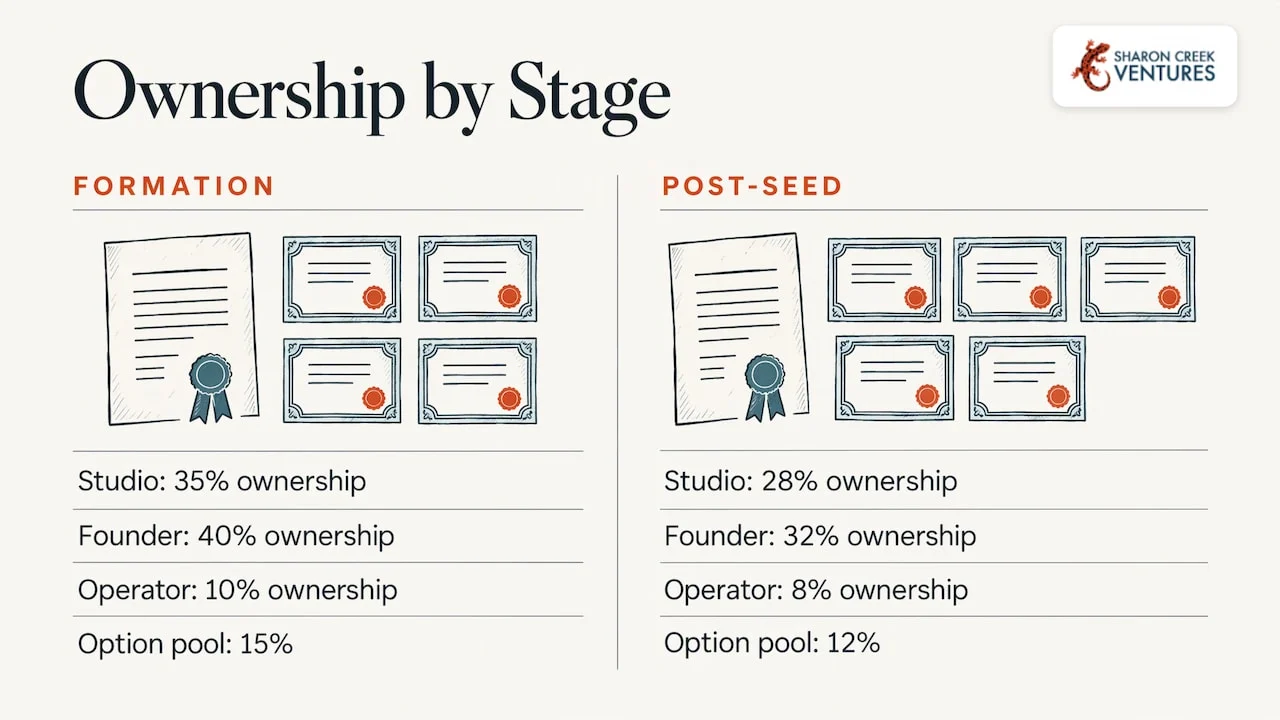
The founder's percentage fell, but the company now has capital, a permitted site path and a team. The real question is whether 32% of a financeable project beats 100% of an idea without funding. Run that comparison with your own numbers, and ask what milestones release your unvested shares.
Our perspective
Equity in a studio should be earned by work that a lender or investor can see. In our experience, the energy projects that get financed are the ones where someone has already resolved the permitting, contracting and capital questions, and that is the work a founder-side partner should be doing for its stake.
Our background is operational. Sam funded and developed Synthica's St. Bernard project, a $70M food waste digester in Cincinnati, through a joint venture with UGI Energy Services, a division of UGI Corporation, a $9B energy utility. It came online in May 2025. Synthica Energy was later acquired by Goldman Sachs Asset Management in 2023. Synthica's San Antonio, TX and Rome, GA projects had their groundbreakings in late 2024 and are still in development. Sam also permitted Synthica digester sites in Houston, TX, Lebanon Junction, KY, Rome, GA, St. Bernard, OH and San Antonio, TX.
That is why we think about studio equity as a trade for execution, not as a tax on an idea. When we form a venture, the question we start with is what it takes to make the project buildable and financeable, and the ownership discussion follows from that. We are not pursuing U.S. anaerobic digester development at this time because of outstanding commitments, and our venture studio work focuses on areas such as nuclear, woody waste-to-fuel and agricultural waste-to-fuel.
Sam
Working with Sharon Creek Ventures
We advise energy founders, developers and boards on capital strategy, board leadership, commercialization and contracting, and project development planning, and we form new energy companies through our venture studio. Studio arrangements can include equity for services. If you are deciding whether a studio structure fits your project, or want a second look at terms you have been offered, start at our Work With Us page. For a longer explanation of the model, read how the venture studio model works.
FAQ
How much equity does a venture studio take?
Classic studios commonly take 10% to 40%, according to the GPCA's 2026 report, and the stake can reach 80% when the studio builds almost everything. The size follows the studio's capital, operating role and team-building.
Does the studio's equity dilute over time?
Yes. When the company raises seed or later rounds, new shares are issued and every holder, the studio included, owns a smaller percentage. What you should check is the studio's rights in those rounds, such as pro rata or protective provisions, and how your own vesting works.
What documents should I review before joining a studio?
Ask for the Services Agreement, Stock Purchase Agreement, Vesting Agreement, IP Assignment Agreement and Stockholders' Agreement, the five documents Rausa Russo Law describes for a clean engagement. Have your own attorney review them, and confirm any 83(b) election deadline with your tax adviser.
Is a studio the same as an accelerator or a VC?
No. An accelerator typically works with a team that already runs, and a VC invests in an existing company. A studio creates the company with you, which is why its stake is larger and its involvement deeper.
Sources
- Venture Studios: An Emerging Model for Company Creation, GPCA 2026
- Venture Studios as Catalysts for Innovation: A Comparative Analysis, CCSE journal
- Structuring Studio Engagements, Rausa Russo Law
- Founder Agreement Template: Equity Splits, Vesting, and IP Assignment, Promise Legal