Clean Energy Partnerships: How to Structure Ones That Get Financed
How energy founders, developers and investors structure clean energy partnerships: models, roles, risk allocation, U.S. programs and what lenders need to see.

A clean energy partnership works when each party carries the risk it is best placed to manage, and when the agreement says so in writing before money moves. For founders, developers, boards and investors, the partnership is rarely the hard part. The hard part is the structure: who funds development, who decides, who is paid first and what happens when a cost overrun or a delay arrives. We advise energy founders and boards on capital strategy, board leadership and venture studio formation, and this guide sets out how to build a partnership that a lender or investor can finance.
TL;DR
- A clean energy partnership pairs different strengths, usually technical or development expertise with capital or credit support, and allocates costs, risks, governance and revenues in an agreement.
- Risk should follow responsibility: the party that controls an outcome should carry the related risk, and the agreement should say how future capital is called and how disputes are resolved.
- Lenders and investors look for proven technology, an experienced development team, strong engineering, procurement and construction (EPC) partners and a project size that matches your resources.
- U.S. programs such as DOE national laboratory agreements, GAIN vouchers and the Loan Programs Office can supply expertise, demonstration support or debt, but each has its own eligibility rules.
- Founders who need operating help alongside capital strategy can start at our work with us page.
Table of Contents
- What a clean energy partnership actually is
- Partnership models, from the lab to the plant
- Choosing a partner and defining roles
- Allocating risk and financing responsibility
- From pilot to financeable project
- U.S. programs that can anchor a partnership
- Where we fit
- Our perspective
- FAQ
- Sources
What a clean energy partnership actually is
In practice, a clean energy partnership is an arrangement in which parties with different expertise, capital and motivations develop a project together. According to a 2019 Norton Rose Fulbright guide to joint arrangements for renewable projects, these agreements allocate development responsibilities, costs, risks, governance and revenues among the parties.
The same guide describes a common pattern: an experienced developer that lacks the credit-support capacity to carry a project teams up with a capital partner. The developer brings sites, permits, interconnection work and relationships. The capital partner brings money, credit support or both. Neither could reach financial close as easily alone.
That pattern holds well beyond solar and wind. A founder with a first-of-a-kind fuel process, a nuclear fuel supply chain or a waste-to-fuel facility faces the same gap between what the team knows and what a lender needs to see.
It also helps to separate three things people call partnerships:
- Joint development arrangements between a developer and a capital partner, covering how a project is advanced to construction.
- Technology and research partnerships, where a company works with a national laboratory, university or public agency to prove a technology.
- Commercial partnerships, such as offtake, feedstock supply, EPC and operations agreements, that make a project bankable.
A strong project usually needs all three, and they have to fit together.
Partnership models, from the lab to the plant
The right model depends on where the technology and project sit. A 2022 study in Frontiers in Energy Research describes public-private research partnerships and cooperative research agreements that give companies access to national laboratory tools and facilities, along with publicly supported demonstrations that help validate technologies for commercialization. It also argues that public agencies can steward shared testing facilities and standards, and that early public investment can de-risk projects and draw in private commercialization capital.
| Stage | Typical partnership | What it solves | Main watch-out |
|---|---|---|---|
| Research and early validation | Cooperative research agreement or lab voucher with a national laboratory | Access to test facilities, modeling and expertise | Intellectual property terms and scope of work |
| Demonstration | Publicly supported demonstration with industry and host sites | Proof that the technology works at scale | Who owns the asset and who pays for overruns |
| Development | Joint development agreement between developer and capital partner | Funds development costs and credit support | Decision rights, future capital calls |
| Construction and operation | EPC, supply, offtake and operations contracts | Makes cash flows and construction risk bankable | Gaps between contracts, interface risk |
| Venture formation | Studio or founder-and-sponsor structure | Builds a company around a hard project | Equity split and governance from day one |
Most failures we see described in the sector are not failures of one partner. They are gaps between these layers: a joint development agreement that says nothing about what happens if the technology demonstration slips, or an offtake contract that a lender will not accept because the feedstock contract behind it is not firm.
Choosing a partner and defining roles
Choose partners for what they actually bring. The Norton Rose Fulbright guide frames this as a match of different industry expertise, capital and motivations. That last word matters. A strategic investor may want supply security. A financial investor may want a return on a set timeline. A public agency may want deployment in a particular region. A developer wants to reach construction. None of these is wrong, but they pull on the project differently.
Before you sign, write down answers to these questions:
- Who leads development and who funds it? Spell out the standard development activities (permitting, site control, interconnection, contracting) and which party carries each.
- How are project costs paid? A joint development agreement typically explains how development costs are funded, and whether the payments are loans, equity or credits against later ownership.
- What information and approval rights does each party have? The guide notes a capital partner may want information and access rights without approval over every development decision. Giving a funder visibility without a veto over daily choices keeps the developer able to move.
- How is governance set? Define board seats, reserved matters that need consent, and who breaks a tie.
- What happens to future capital? Say how additional contributions are requested, what happens if a party cannot fund, and how that party is diluted or compensated.
- How are revenues shared? Decide the order of payments and how returns change as milestones are met.
- How are disputes resolved? Pick the procedure, forum and any cooling-off steps before a disagreement exists.
This list is where a partnership agreement earns its keep. A handshake alignment that feels fine at the pilot stage can become a deadlock at financial close, when lenders ask who can bind the project company and who can approve a change order.
Allocating risk and financing responsibility
The rule of thumb in the same guide is that risk should flow from responsibility. The party that controls a cost or a schedule should carry its consequences. In a typical joint development arrangement, the capital partner provides money or credit support while the developer handles the standard development work. If the developer is paid for that work only on success, the agreement should say how the capital partner is protected if the project stalls for reasons the developer could not control.
A practical way to test an allocation is to walk through four events and ask who pays and who decides:
- A permit takes twelve months longer than planned. Who funds the carrying cost, and does the capital partner have a right to walk?
- Technology performance falls short in demonstration. Does the project proceed, pause or restructure, and who owns the data?
- Construction costs rise. Who funds the overrun, and is there a cap on how much any party must put in?
- A key counterparty fails. Whether it is a feedstock supplier or an offtaker, which party carries the replacement risk?
Lenders will ask the same questions. A 2024 DOE report on first-of-a-kind financing and development approaches notes that bankable-project checklists include fully wrapped EPC contracts with top-tier EPC firms. A fully wrapped contract puts design, procurement and construction responsibility, and the related performance risk, with a single contractor. That is one example of how a commercial partnership shifts risk to the party able to manage it.
For a deeper look at how financing structures follow from these allocations, see our guide to project finance advisory for energy developers.
From pilot to financeable project
A pilot partnership proves a technology. A financeable partnership proves a project. They are different tests, and many teams discover the gap only when they approach lenders.
The Stanford Law School 2024 Guidebook for Early Climate Infrastructure recommends addressing investor concerns in three ways: show that the technology is well proven, ideally demonstrated at commercial scale; build an experienced development team with strong EPC partners; and choose a project size that balances economies of scale against the resources the team can actually bring, while keeping the design repeatable. It also notes that operational obligations can be assigned to partners or customers.
Turn that into a self-assessment before you open a capital raise:
- Technology evidence. Do you have operating data at a scale a technical advisor will accept? If not, which partnership (laboratory, demonstration host, equipment vendor) closes that gap?
- Team depth. Has anyone on the team taken a comparable project from development to operation? If not, who joins as a partner, board member or advisor?
- EPC and supply chain. Is there a credible contractor willing to take performance risk, and are feedstock or fuel supplies contracted?
- Project size. Is the first project large enough to matter economically but small enough to finance and build with the team you have?
- Offtake and revenue. Do contracts support the cash flows in your model?
- Operations. Who runs the facility, and which obligations pass to partners or customers?
Our articles on what makes a difficult energy project buildable and how hard projects reach the market walk through these dependencies in more detail. If you want the whole development path, renewable project development stages, risks and financing covers it end to end.
U.S. programs that can anchor a partnership
Public programs are often the first partner a technology company signs. Three are worth knowing, with the caveat that each has its own eligibility and application rules, which change. Always read the program's official page for the current process.
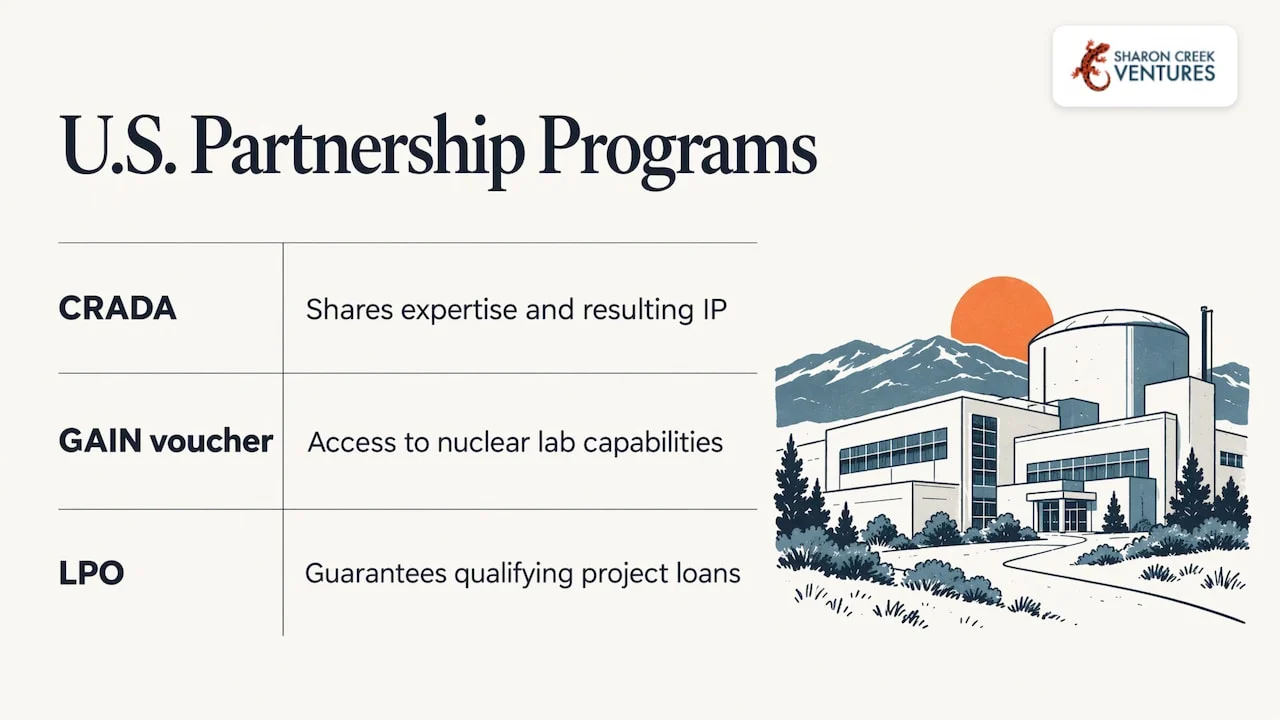
National laboratory agreements. A cooperative research and development agreement, or CRADA, is a written agreement between a non-federal partner and a DOE laboratory contractor. Idaho National Laboratory's CRADA overview explains that it lets the partners share technical expertise in a protected environment, share intellectual property that emerges from the work and advance commercialization of federally developed technology. DOE provides a standard document to start negotiations, and some provisions can be negotiated.
GAIN vouchers for nuclear. The Gateway for Accelerated Innovation in Nuclear gives companies access to the research capabilities and expertise across the DOE national laboratory complex. In December 2024, DOE announced four vouchers covering fuel and reactor technologies, one example of how a small company can pair with a laboratory on a specific technical question. Voucher rounds recur, so check the Office of Nuclear Energy page for the current schedule.
Loan Programs Office. The DOE Loan Programs Office can guarantee loans for qualifying clean energy projects. According to a GAO review of the program, eligibility requires an energy-related project located in the U.S. that involves technically viable and commercially ready technology and shows a reasonable prospect of repayment. That last test is why the partnership questions above matter: a lender reads your agreements to judge repayment, not just your technology.
Public programs are rarely enough alone. They validate technology and lower early risk, and the private partners (capital providers, EPC firms, offtakers) still have to be in place for the project to close.
Where we fit
If you are a founder or developer with a hard project, a board weighing a capital structure, or an investor looking for development-stage opportunities, our work centers on three offers: capital strategy, board leadership and venture studio formation. Our team's experience comes from founder-side execution on prior energy projects, and we focus on the commercial, technical and financial dependencies that decide whether a project can be financed and built. Our areas of interest include woody waste-to-fuel, agricultural waste-to-fuel and grid-scale storage projects. You can see how to engage us on our work with us page.
Our perspective
Most partnership problems we see described in energy begin as sequencing problems. Teams sign the exciting partnership first, a lab, a strategic investor or a supplier, and leave the structure underneath it for later. By the time a lender asks who decides, who funds the overrun and who stands behind performance, the answers are fixed in documents nobody designed for that question.
Our view is that the structure should be designed backward from financeability. Start with what a lender and an equity investor will need to see at close, then work out which partners and which terms produce it. That is why we put capital strategy, governance and commercialization in the same conversation rather than treating them as separate workstreams.
It is also why founder-side experience matters. Having been on the side of the table that has to build the thing, we pay attention to the practical dependencies: contractor scope, feedstock, interconnection, operations. A partnership that handles those is one a board can approve and a capital provider can underwrite.
For founders, our advice is to bring us in before the term sheet, not after. For boards and investors, it is to ask who in the partnership has done this before. That question usually reveals where the structure needs work.
Sam
FAQ
What is the difference between a joint development agreement and a joint venture?
A joint development agreement governs how partners advance a project to a decision point, usually construction, and how development costs are funded. A joint venture typically creates a lasting entity or ownership structure. Many projects start with the first and convert to the second at financial close, so draft the first with that conversion in mind.
Who should lead a clean energy partnership, the developer or the capital partner?
Let the party with the relevant expertise lead each area, and match decision rights to responsibility. A developer usually leads permitting, site and contracting work, while a capital partner often wants information and access rights rather than approval over every choice. Reserved matters, such as budget changes or a sale of the project, can still require the capital partner's consent.
Can a small company partner with a national laboratory?
Yes. CRADAs and GAIN vouchers exist for companies to work with DOE laboratories, and the 2024 GAIN awards included small companies. Each program has its own application process and terms, so read the program's current official page before you plan around it.
What do lenders look for in a clean energy partnership?
They look for proven technology, an experienced development team, strong EPC partners and a project size that fits the team's resources. They also read the agreements to see how risk, future capital and disputes are handled. The DOE Loan Programs Office, for example, requires technically viable, commercially ready technology and a reasonable prospect of repayment.
When should a founder bring in outside advisory help?
Bring in help before you commit to a structure that will be hard to change: before a term sheet, before a board is formed and before a capital raise is launched. Early work on capital strategy and governance is cheaper than renegotiating after a partner is in place. You can reach us through our work with us page.
Sources
- Joint arrangements to develop renewable energy projects, Norton Rose Fulbright (2019)
- Clean energy technology pathways from research to commercialization, Frontiers in Energy Research (2022)
- First-of-a-kind financing and development approaches, U.S. Department of Energy (2024)
- Guidebook for Early Climate Infrastructure, Stanford Law School (2024)
- Cooperative research and development agreement overview, Idaho National Laboratory
- GAIN vouchers awarded, U.S. Department of Energy (December 2024)
- DOE Loan Programs: actions needed to address authority and improve application, GAO