
When Feedstock Variability Becomes a Financing Risk
Feedstock variability becomes a financing risk when changes in the material can alter usable supply, throughput, yield, availability, product quality, or operating cost, and the project has no credible way to measure, control, price, allocate, or absorb the consequence. At that point capital providers cannot rely on the supply case, however many tons appear to exist nearby.
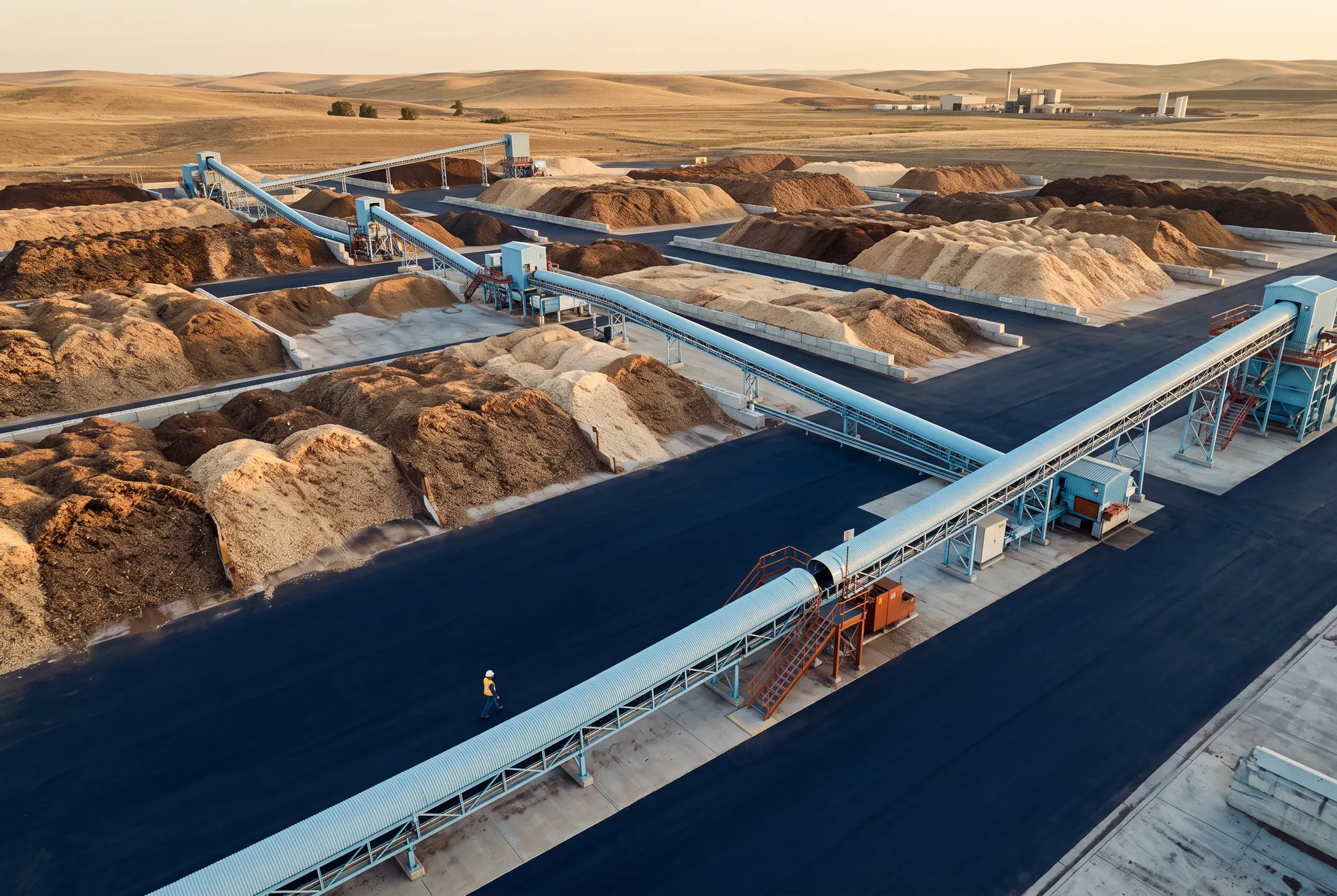
The threshold matters because a project does not have financeable feedstock merely because enough tons appear to exist within a radius. It has financeable feedstock when the development team can show which attributes matter to the selected conversion pathway, how those attributes vary, what the plant can tolerate, who measures them, which system manages them, and who bears the consequence when material arrives outside the expected range.
The U.S. Department of Energy’s Feedstock-Conversion Interface Consortium was created around this problem: understanding, quantifying, and mitigating feedstock variability to reduce risk in biorefinery scale-up and deployment. For developers and capital providers, the practical question is how that technical variability moves through the supply chain, plant, contracts, and financial model.
Available tons are not the same as usable tons
A resource assessment may show a large quantity of forest residue, agricultural material, or other biomass in a region. That estimate is a starting point, not an underwritten supply case.
Some of the material may be unavailable because of competing uses, collection limits, distance, seasonality, or land-management constraints. Some may be deliverable but fall outside the conversion system’s useful range. Moisture, ash, particle-size distribution, contamination, degradation during storage, and chemical composition can all matter, but they do not matter in the same way for every process.
DOE’s Feedstock Supply Chain Analysis connects organic composition to yield, particle-size distribution to convertibility and losses, flow properties to throughput, and moisture and ash to potential throughput failures. The same analysis notes that variability can reduce the amount of regional feedstock that meets conversion specifications and weaken biorefinery economics.
A project therefore needs two related answers:
- How much material can the supply system deliver?
- How much of that material can the plant use economically within its design and operating limits?
If those answers are treated as the same number, the project may overstate dependable supply before it has tested quality, cost, and performance together.
Six controls turn variability into an underwritable system
No single contract clause or preprocessing step makes variable feedstock financeable. The project needs a connected control system across technical, commercial, and financial work.
1. Define the attributes that matter
The first job is not to write a generic biomass specification. It is to identify the material attributes that matter to the selected conversion pathway and equipment.
An Idaho National Laboratory paper on effective feedstock specifications discusses characteristics including moisture, ash, structural carbohydrate content, grind or particle size, and other physical and chemical properties. It also notes that storage can create dry-matter loss and reduce convertibility, while ash can affect pretreatment and increase wear in handling and feeding systems.
The specification should connect each critical attribute to a consequence:
| Attribute or condition | Question the project must answer |
|---|---|
| Moisture | Does it change usable dry matter, storage behavior, flow, drying load, or conversion performance? |
| Ash or soil contamination | Does it reduce useful feedstock content, increase wear, create disposal burden, or affect product quality? |
| Particle size and shape | Can receiving, conveying, feeding, and conversion equipment handle the actual distribution? |
| Composition | Which components drive yield, inhibitors, emissions, coproduct quality, or downstream processing? |
| Storage degradation | How do time, temperature, weather, and handling change mass, quality, and convertibility? |
| Extraneous material | Who identifies, removes, transports, and pays for material the plant cannot process? |
The relevant thresholds will differ across biochemical, thermochemical, mechanical, and other pathways. A number borrowed from another project may create false confidence.
2. Measure a representative supply—not an ideal sample
A specification has little value if the project cannot show how actual deliveries will be sampled and tested.
The measurement plan should address:
- where and when samples are taken;
- whether the sample represents a field, pile, truck, lot, supplier, season, or blended inventory;
- which test method controls;
- who holds and audits the data;
- how quickly results are available;
- how disputes are resolved; and
- how the project responds when a trend moves toward or beyond a limit.
The goal is not to create a laboratory program detached from operations. It is to produce information early enough to change procurement, blending, storage, preprocessing, or plant operation before variability becomes lost throughput or missed performance.
Publicly filed biomass agreements show how commercial parties have used specifications, certification, sampling, testing, cure, and rejection mechanisms. Those examples demonstrate available tools, not universal terms. The right system depends on the material, conversion process, delivery point, counterparties, and financing structure.
3. Design the supply and plant systems around realistic ranges
A project cannot contract its way out of every physical problem.
National-laboratory work on robust feedstock preprocessing describes preprocessing as the work required to turn raw biomass into a more uniform, reactor-ready material. The system must handle variability while maintaining reliability and throughput, producing feedstock within conversion specifications, and limiting losses such as excess fines.
Preprocessing design may require decisions about:
- covered or controlled storage;
- drying;
- screening and contaminant removal;
- grinding or size reduction;
- blending across sources or lots;
- surge capacity and inventory;
- redundant or maintainable handling equipment;
- instrumentation and rapid testing; and
- an operating envelope that reflects actual material rather than a nominal design point.
DOE’s forest-residue air-classification case is one example of treating feedstock quality management as a system-level design and economic question. It evaluates a preprocessing intervention alongside ash and carbon specifications, throughput, operating effectiveness, delivered cost, and minimum fuel selling price.
The broader lesson is not that every project needs the same equipment. It is that every quality mitigation has a cost, location, owner, capacity, and expected effect that should appear in design and economics.
4. Contract for ranges and consequences
A supply agreement should connect what can be delivered to what the plant can accept. One nominal quality target is rarely enough.
An AgMRC paper on biomass supply issues and agreements links a detailed quantity-and-quality supply study to the project economic model and negotiated agreement. It discusses specifications, inspection, sampling, rejection, removal responsibility, agreement term, and supply for commissioning and performance testing.
Depending on the project, the commercial structure may need to address:
- acceptable ranges and rejection thresholds;
- representative test methods;
- price adjustments tied to usable dry matter or quality;
- cure, blending, or substitution rights;
- make-up volume after a rejected or short delivery;
- responsibility for unloading, removal, transport, and disposal;
- seasonal delivery profiles and storage ownership;
- data access and audit rights; and
- change control when the supply source or process changes.
Feedstock contract terms are allocation questions, not boilerplate. A strict rejection right may protect the plant but still leave it without enough material to operate. A broad acceptance obligation may preserve volume while transferring quality and disposal costs into the project. The financeability question is whether the total structure keeps supply, plant performance, and commercial obligations aligned under plausible conditions.
5. Put variability into the financial model
A project model should not assume that every delivered ton creates the same output at the same cost.
Feedstock quality can affect economics through:
- usable dry matter per delivered ton;
- preprocessing energy and consumables;
- throughput and operating hours;
- conversion yield;
- maintenance and wear;
- rejected-material handling and disposal;
- replacement supply and transport;
- storage loss;
- working inventory; and
- the project’s ability to meet product specifications or delivery obligations.
A DOE FCIC techno-economic case study shows one pathway-specific example in which feedstock-derived variability affected fermentation performance, fuel yield, and modeled selling price. The reported results should not be generalized across technologies. The transferable point is that when variability changes rate or yield, the effect can propagate into project economics.
A useful model does not need to simulate every truckload. It should test a few coherent cases: expected material, a persistent shift within the operating range, and an adverse but plausible condition outside it. Those cases should connect the same assumptions across supply volume, quality, throughput, yield, availability, cost, and commercial performance.
6. Give someone ownership of drift
Feedstock risk changes over time. Sources enter or leave the supply shed. Harvest and weather conditions change. Storage practices evolve. Equipment wears. Suppliers blend material differently. The project learns which attributes are actually critical.
Someone must own the current view of:
- incoming quality distributions;
- supplier and seasonal trends;
- process response;
- contract performance;
- financial-model assumptions; and
- decisions to change procurement, preprocessing, operating limits, or commercial terms.
Without that ownership, each function can work from a different version of the feedstock case. Procurement may optimize delivered price, operations may absorb declining quality, engineering may rely on the original design basis, and finance may continue using an assumption that no longer describes the plant.
Questions capital providers should ask
A feedstock diligence review should be able to answer:
- Which material attributes are critical to this conversion pathway, and what evidence supports that conclusion?
- What distributions were measured across suppliers, seasons, storage methods, and representative lots?
- How much regional material remains usable after quality requirements, losses, and delivered cost are applied?
- Which variability is removed or reduced through storage, preprocessing, blending, and operating controls?
- Which variability remains, and where does its consequence appear in the model?
- How do supply agreements handle testing, adjustment, rejection, cure, replacement, and disputes?
- Are feedstock, equipment, product, and financing obligations based on compatible ranges and dates?
- Who monitors drift and has authority to change the response?
If the answer to a quality question is simply “the supplier is required to meet the specification,” diligence is not finished. The project still needs to show that the specification is achievable, measurable, enforceable, and compatible with the available supply and plant design.
The financeability test
Sharon Creek’s existing guide to waste-to-fuel project financeability explains that feedstock, logistics, conversion, offtake, site, and capital must work as one system. Feedstock variability is one of the interfaces where that system can quietly become inconsistent.
The project has moved beyond a resource estimate when it can show:
- the attributes that matter;
- the range expected in real supply;
- the effect of that range on plant and product performance;
- the controls that reduce or absorb variability;
- the contracts that allocate the remaining consequences; and
- the model that reflects those same conditions.
A project that documents all six items has reached the point where variable feedstock begins to look less like an open-ended operating exposure and more like a risk that customers, boards, and capital providers can evaluate.
Sharon Creek brings an operator’s perspective to these connected development questions. Sam Schutte’s prior work leading the Synthica St. Bernard project from concept into commissioning is documented separately; Sharon Creek Ventures is an independent firm, and the project record is presented as founder experience rather than a current Sharon Creek engagement.
For related market perspectives, see Sharon Creek’s work on woody waste to fuel and agricultural waste to fuel.
Test the feedstock case
If your project needs to connect supply assumptions, conversion requirements, contracts, and capital into one defensible case, start a conversation.
Sources
- DOE — Feedstock-Conversion Interface Consortium
- DOE — Feedstock Supply Chain Analysis
- OSTI/Idaho National Laboratory — Evolution and Development of Effective Feedstock Specifications
- OSTI — Key Factors in Designing a Robust Biorefinery Feedstock Preprocessing System
- DOE FCIC — Air Classification of Forest Residue
- DOE FCIC — Fermentation Cost Impacts from Selected Critical Material Attributes
- AgMRC — Biomass Supply Issues and Agreements
- Idaho National Laboratory — Biomass Supply Chain Risk Standards